Saturday, April 02, 2016

10 INTERESTING FACTS ABOUT INDIA POST

India has the largest postal network in the world with 1,54,939 post offices as on March 31, 2015, of which 1,39,222 (89.86%) are in the rural areas. At the time of independence there were 23,344 post offices.

Following are some interesting revelations from India Post’s annual report 2015-16.

  1. The government has decided to digitise 1.5 lakh post offices across the country, which includes 1.3 lakh post offices in rural areas.
  2. One can buy exclusive collection of postal stamps offered by India Post on e-commerce websites like Snapdeal and Shopclues. Philatelic products are also available at e-post office – an e-commerce portal of India Post. Through its e-commerce portal, India Post also provides select postal facilities using the web. The department has generated revenue of Rs 24.31 lakh between April 2015 and December 2015 by selling postal stamps. 
  3. India is one of the earliest active members of the Universal Postal Union (UPU), a specialised agency of the United Nations, having its headquarters at Berne, Switzerland. 
  4. There are more than 33.03 crore account holders of the savings scheme of the department.
  5. The outstanding balance under all the savings schemes and saving certificates in Post Offices are over Rs 6,19,317.44 crore.
  6. Money transfer service of India Post enables instant international money remittance to customers in India sent from 195 countries on real time basis. This service is operational in association with Western Union from 9,942 post office locations and MoneyGram through 6,070 post office locations.
  7. To ensure safe and timely delivery of goods, the department has signed an agreement for supply and installation of GPS devices in 990 mail vans. GPS devices have already been installed in 926 mail vans.
  8. India Post ATMs have been installed in more than 500 locations across the country.
  9. The department has earned revenue of Rs 2,247 crore during the period April 2015 to December 2015 registering a growth of 15% compared to corresponding period last year.
  10. The department has 38 heritage buildings having architectural value. 

DISCONTINUATION OF PHYSICAL PRE-PRINTED NSC AND KVP CERTIFICATES

It is decided that the currently existing system of physical pre-printed certificates for KVP and NSC shall stand discontinued w.e.f. 1.4.2016 and shall be replaced by ‘National Savings Certificate/Kisan Vikas Patra Certificate on electronic - mode (e-mode). Till the CBS system transits to that e-mode, banks and post offices may choose to issue a physical certificate recorded on a passbook.

The serial numbers based on the new pattern allotted to the banks and the Department of Posts (DoP) with respect to KVP and NSC were detailed in the said Finmin’s OM of even number dated 23rd March. It is intimated that while issuing the certificate from 01.04.2016, Banks and Post Offices may use notification having G.S.R. No. 353 (E) dated 29.3.2016 for Kisan Vikas Patra and notification having G.S. R. No. 354 (E) dated 29.3.2016 for National Savings Certificate. It is intimated that these notifications are available on egazette.nic.in


Friday, April 01, 2016

NFPE NEWS : MEETING WITH CABINET SECRETARY ON PAY COMMISSION ISSUES

A meeting with Cabinet Secretary Sri. P. K. Sinha was held at Cabinet Secretariat Committee Room, Rashtrapati Bhawan, New Delhi on 30.03.2016.

All Members of empowered committee i.e. Secretaries of Various Departments were present in the meeting. Department of Post was represented by Sri. Ashutosh Tripathi, Member (Personal), Sri Shailendra Dashora, DDG (Estt) Ms. Manju Pandey, DDG (Personal) & Ms. Anju Nigam DDG (SR), from NFPE Com. R. N. Parashar, Secretary General NFPE & General Secretary P3, Com. Giriraj Singh, President NFPE & General Secretary, R3 & Com. R. Seethalakshmi, Dy. Secretary General, NFPE & General Secretary P4, from FNPO, Com. D. Theagrajan, Secretary General, FNPO& General Secretary R3, Com. T. N. Rahate, President FNPO & General Secretary P4 and from BPEF, Com. S. K. Sinha, General Secretary Postal Accounts Association participated.

We presented our views in support of each and every demand submitted by NFPE & FNPO in memorandum to Pay Commission and Empowered Committee and implementation cell. We demanded upgraded scales for each cadre of Department. The meeting was held in a very congenial atmosphere. We may hope for the better.

7TH CPC DA : A DECADE-LONG JOURNEY BEGINS!

“The Dearness Allowance calculations as per the recommendations of the 6th Central Pay Commission come to an end; the method prescribed by the 7th Central Pay Commission comes into effect from Jan 2016 onward…!”

The 7th Central Pay Commission was appointed in order to evaluate the methods of calculating the salaries, incentives, benefits, pensions, retirement benefits, and Dearness Allowance of the Central Government employees and serving and retired personnel of the Indian defence forces, and suggest changes, if and when required. Four months have passed since the Central Pay Commission submitted its final report to the Centre.

The government at the centre has the discretion to accept, reject, or modify the recommendations made by the Central Pay Commission. It has constituted a high-level committee to look into the various suggestions in the report. The final decision on the implementation of the recommendations will be made based on the feedback from this empowered committee.


Meanwhile, the Central Government employees federations met with the high-level empowered committee to discuss various issues, including Minimum Wages and Fitment Factor, and to suggest required amendments in the report.


There is likely to be a delay in the publication of the notification containing the accepted recommendations by the 7th Pay Commission. Since the election Model Code of Conduct will be in place until the last week of May 2016, the Government acceptance notification is expected to be published in the first week of June. In that case, there are chances that the revised salaries will be issued from the month of June. Also, the arrears for the past five months are also likely to be released then.


Dearness Allowance is one of the much-anticipated topics among Central Government employees. In its report, the 7th Central Pay Commission had given a short explanation about Dearness Allowance.


The 6th Central Pay Commission suggested elaborate changes in the method of calculating Dearness Allowance. This time however, the 7th Central Pay Commission did not suggest any elaborate changes. It has suggested that the same process be continued.


We have presented a ready reckoner of the procedures that were followed when the 5th Central Pay Commission drew to a close and the 6th Central Pay Commission came into effect, which are very likely to be followed this time too.


The AICPIN points of only the month of January are available as of now. The AICPIN points for February will be released tomorrow.


You can come up with approximate AICPIN points for the remaining four months to calculate the approximate Dearness Allowance.


As of January 1, 2016, according to the Centre, the Dearness Allowance stood at 125 percent. An order of the Ministry of Finance to this effect will be released soon. In the event that the 7th Central Pay Commission recommendations come into effect from January 1, 2016 onwards, the salaries of the Central Government employees will be revised by adding 125 percent to their basic pay. The new Dearness Allowance hike will be issued from 01.07.2016 onwards.


For example, if the basic pay of an employee, as on 01.01.2016, is Rs.12,000 (Grade Pay 2800 + 9200), his salary revisions and Dearness Allowance hikes as per the 6th and 7th Central Pay Commission recommendations, are given below.
Employee’s Pay as on 1.1.2016 as per the recommendations of 6th CPC
Basic Pay + 125% DA: 12000 + 15000 = 27000
Employee’s Pay as on 1.1.2016 as per the recommendations of 7th CPC
Basic Pay + No DA: 31000 + 0 = 31000
(No Dearness Allowance for the period between Jan to Jun 2016 and the first installment of additional DA will be given only on 1.7.2016)

Wednesday, March 30, 2016

Trade unions call nationwide strike on September 2 to protest againt amendments in labour laws

Central trade unions today said they will go on one-day nationwide strike on September 2 to protest against unilateral amendments in labour laws and the governments' indifference towards their 12-points charter of demands. 

At the National Convention, they gave the call for all India general strike on September 2, 2016 under their joint declaration. 

Leaders of the central trade unions including INTUC, AITUC, HMS, CITU, AIUTUC, TUCC,SEWA, AICCTU, UTUC and LPF participated in the convention and signed the joint declaration. 

However, RSS backed Bharatiya Mazdoor Sangh did not turn up for the convention and is not part of the declaration. 

The unions have asked their members to organise a day- long mass Dharna/Satyagraha in state capitals and industrial centres on August 9 (Quit India Day) ahead of the Strike. 

They have also decided to organise joint conventions and campaigns in June-July in states, districts and at industry level and take initiative to involve peasants, agriculture labour and mass of the people in the campaign. 

According to declaration, totally ignoring the united opposition of the workers, the government has been moving fast to demolish existing labour laws thereby empowering the employers with unfettered rights to "hire and fire" and stripping the workers and trade unions of all their rights and protection provided in laws. 

"As follow up to the PMO's written communication to the Chief Secretaries of States, states are bing directed to carry out Rajasthan type pro-management amendments in labour laws. The Labour Secretary has issued executive order on January 12, 2016 granting exemption to so called start-up Enterprises from inspection and application of 9 major labour laws, thereby legitimizing violations," it said. 

Unions also expressed their reservations against proposed Small Factories Bill which provides that major 14 labour laws will not apply to factories employing up to 40 workers. 

Similarly, they opposed that Labour Code on Wages Bill and Labour Code on Industrial Relations Bill saying that "under the cover of amalgamation, these bills seek to make registration of unions almost impossible, making retrenchment and closure almost free for the employers class." 

"These bills have been put in public domain totally ignoring the trade unions thereby violating the provisions of ILO Convention 144 on tripartite consultation. All these amendments are meant to exclude 90 per cent of workforce from application of labour laws thereby allowing the employers to further squeeze and exploit the workers," it said.
Source:-The Economic Times

S B Order No. 02/2016 : Acceptance of POSB business in the case of Finacle CBS application is not accessible or slow to accept transactions presented at the counter - invoking of Business Continuity Plan (BCP) regarding


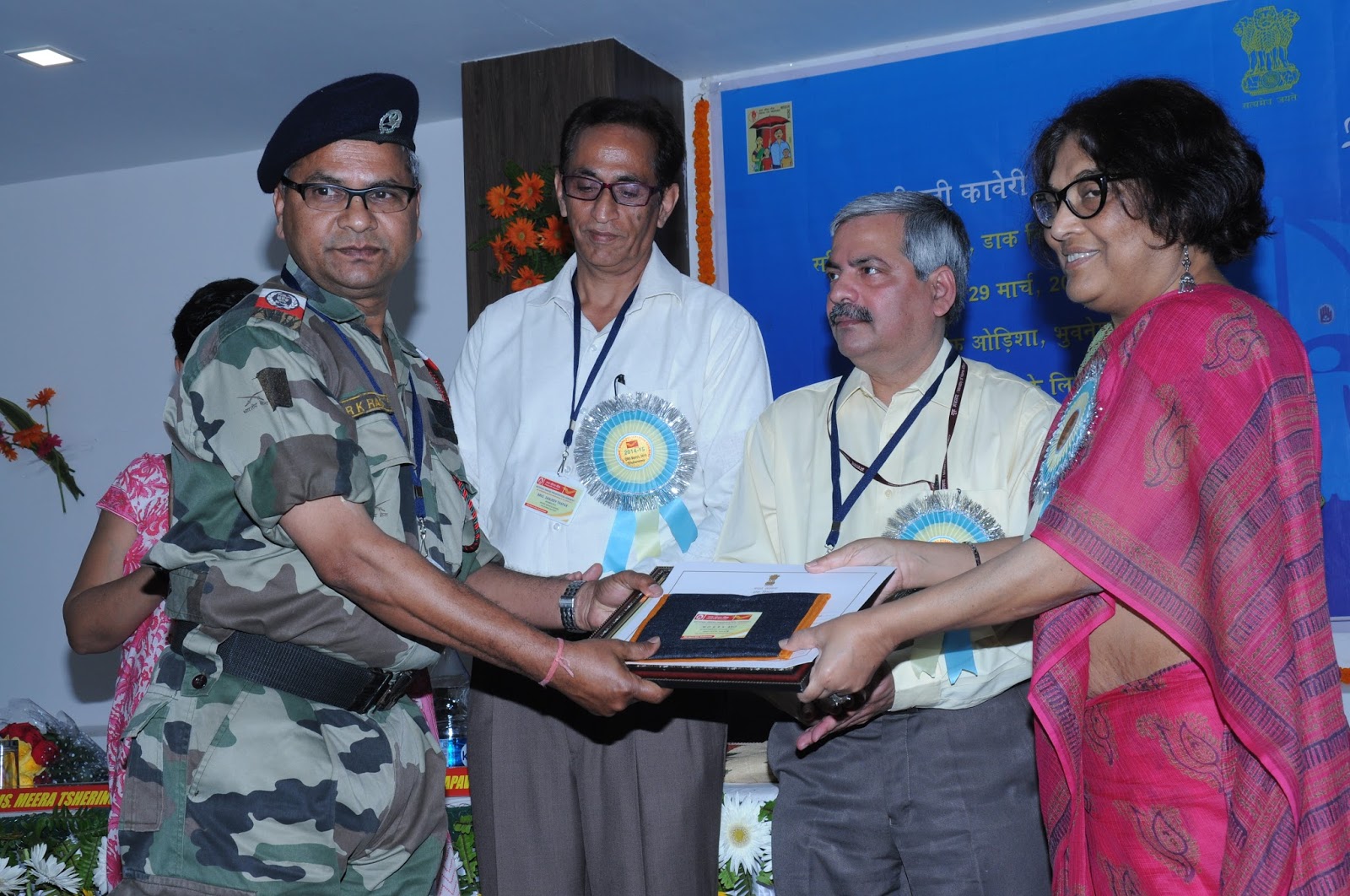
National Award Presentation Ceremony for outstanding business performance in Postal Life Insurance held in Bhubaneswar on 29.03.2016